Case study 01 · Product portfolio transformation

Product Portfolio Transformation

How I led the evolution of a legacy content and commerce portfolio into a measurable, customer-centered system for acquisition, personalization, purchase, and retention.

RoleDirector of Product
TimeframeMay 2014–July 2025
ScopeFull Tarot.com portfolio
LeadershipStrategy + execution oversight

Portfolio scale

16Msessions20%ecommerce conversion
improvement
$4Mannual digital revenue
managed
average yearly value
per new signup

The executive summary

Transforming legacy experiences into a data-driven customer journey.

Tarot.com had enormous audience reach and a deep catalog, but its value was constrained by legacy technology, fragmented journeys, and limited behavioral insight.

I set the portfolio strategy, directed experience and project scope, and oversaw execution across product, design, engineering, content, and marketing. The transformation centered on three moves: measure the journey, turn free content into a growth engine, and connect every customer interaction into a persistent ecosystem.

The starting point

A portfolio with reach—but without continuity

Before

Disconnected destinations

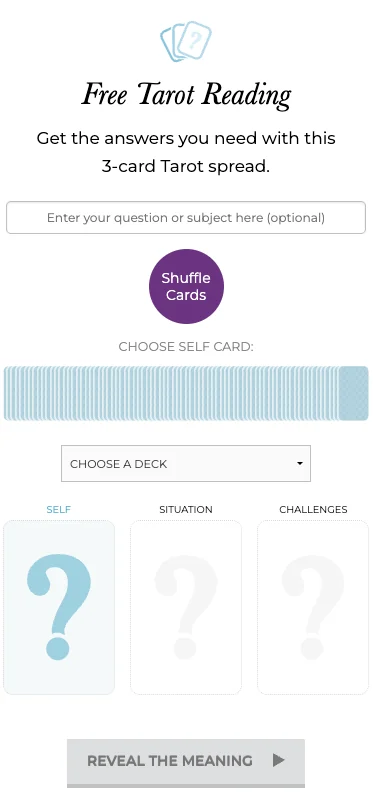
Legacy systems made basic changes expensive. High-reach content, self-guided readings, customer accounts, and commerce operated as separate destinations, so teams optimized isolated touchpoints with little visibility into what moved customers forward.

Legacy Tarot.com desktop homepage
Legacy Tarot.com homepage cropped inside a mobile phone

After

One compounding relationship

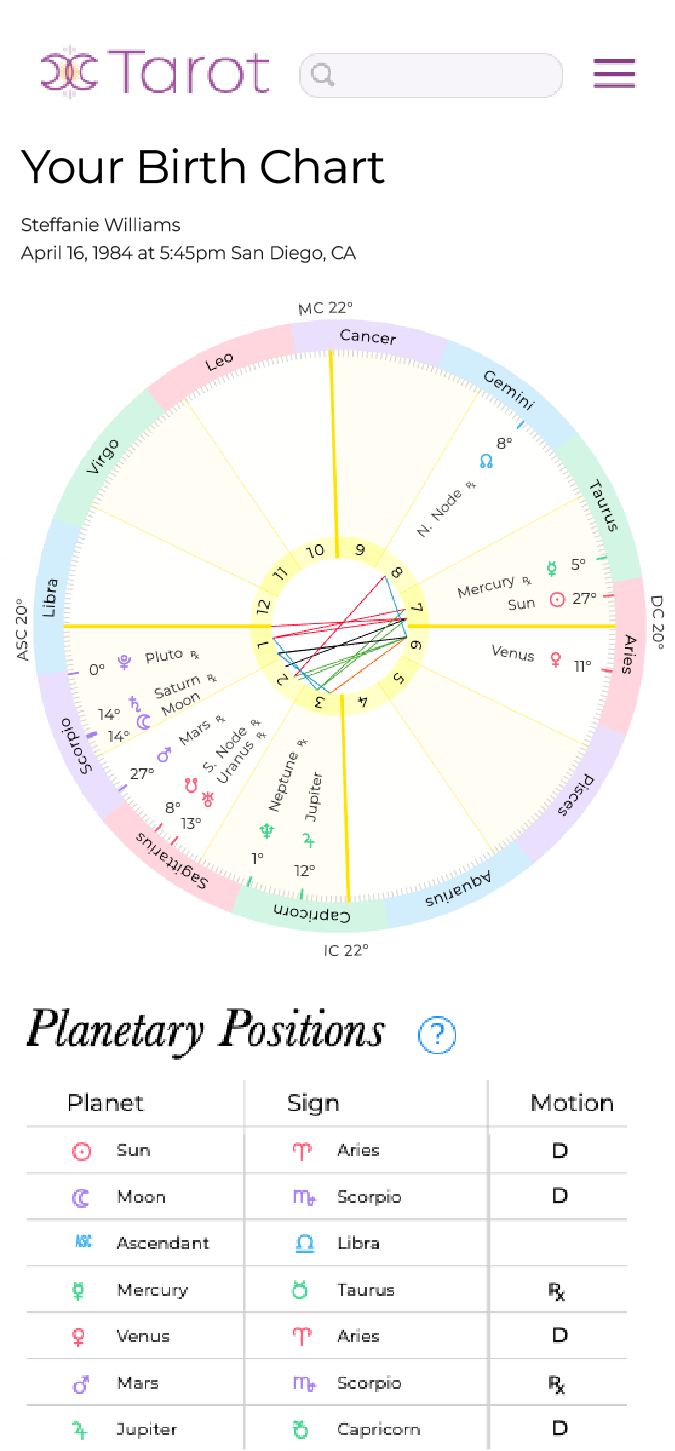
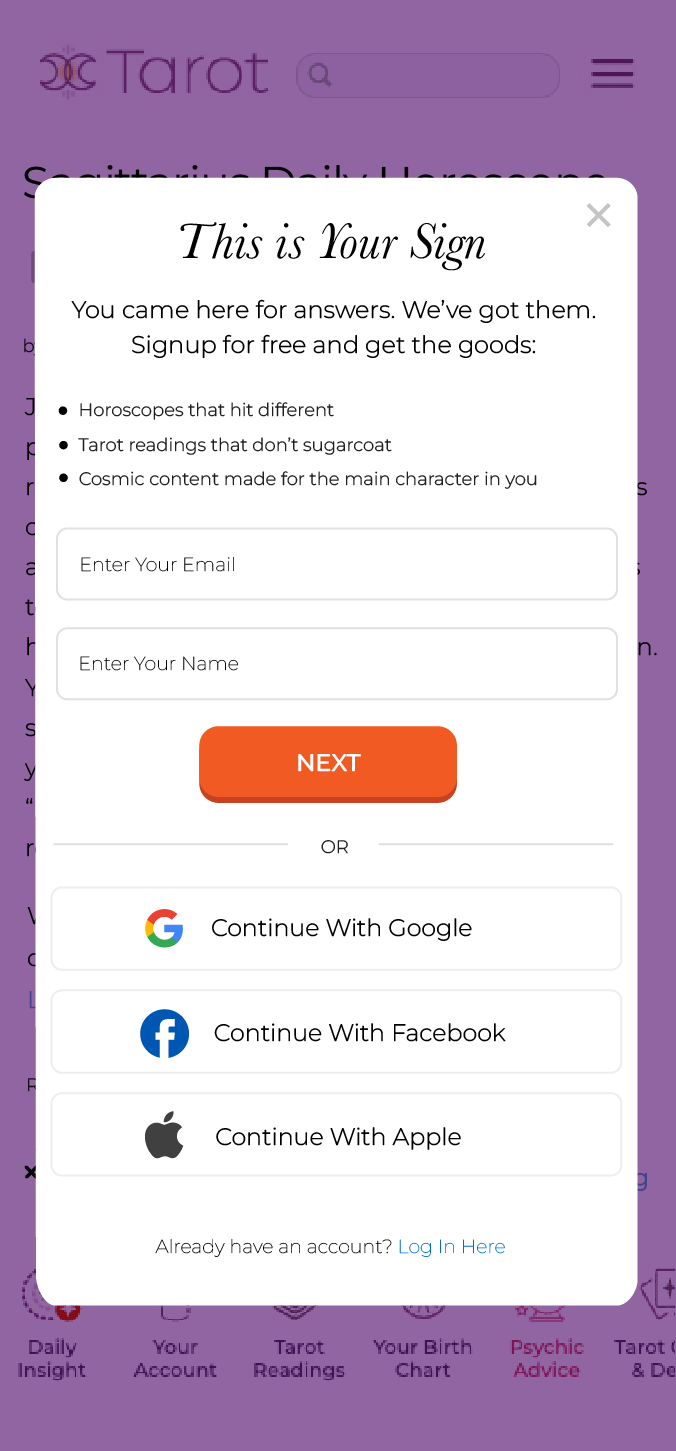
Shared identity, behavioral signals, recommendations, purchases, and saved insight connected discovery, daily engagement, signup, commerce, and return behavior into one measurable customer relationship.

Responsive Tarot.com daily horoscope on desktop
Responsive Tarot.com daily horoscope on mobile

Portfolio opportunities

Four opportunities defined where transformation could create the most value.

I evaluated the portfolio across market demand, customer access, decision quality, and operating leverage. The sequence moves from the most distinctive opportunity to the capabilities required to deliver it.

Market expansion

U.S. psychic-services revenue reached an estimated $1.9 billion in 2014, growing 3.4% that year after five years of sustained growth. Continued expansion was forecast through 2019 as astrology, Tarot, and spiritual guidance gained broader consumer acceptance.

Mobile transformation

U.S. smartphone penetration rose from 69% to 76% during 2014. Capturing the expanding market required replacing legacy desktop experiences with responsive journeys that connected engagement, signup, and purchase.

Decision intelligence

Connect customer behavior, identity, and commercial signals so investment follows shared evidence rather than assumptions.

Operating leverage

Replace large quarterly launches with reusable systems that support frequent improvements while reducing manual work and specialized engineering dependency.

Who we designed for

Six behavior-based personas shaped the connected customer journey.

Different customers found value in different parts of the ecosystem.

This working matrix maps the relative value of each product and member capability to the six behavior-based personas. Ratings are directional hypotheses to refine with behavioral and revenue data.

Free product featuresDaily Guidance UserEngaged ExplorerPurchaserFirst-Time DiscovererTopic-Focused SeekerLoyal Power User
Daily HoroscopesHighHighMediumHighMediumHigh
Daily Tarot ReadingsHighHighMediumMediumMediumHigh
Monthly & Annual ForecastsMediumMediumHighMediumHighHigh
Self-Guided Tarot ReadingsHighHighMediumHighHighHigh
Personal Astrology CalculatorsHighHighHighHighHighHigh
Educational ArticlesMediumHighMediumHighHighMedium
Paid product features
Paid astrology reportsMediumMediumHighMediumHighHigh
Paid love astrology reportsHighHighHighMediumHighHigh
Paid Tarot readingsHighMediumHighMediumMediumHigh
Paid love Tarot readingsHighHighHighMediumHighHigh
Paid I Ching readingsLowLowMediumLowLowHigh
Paid love I Ching readingsLowLowMediumLowLowMedium
Paid numerology reportsMediumMediumHighMediumMediumHigh
Free member features
Virtual currencyMediumMediumHighLowMediumHigh
Personal JournalHighHighHighMediumHighHigh
Free birthday readingHighHighMediumHighMediumHigh
Sun-sign logged-in experienceHighHighMediumHighHighHigh
Transaction historyMediumMediumHighLowMediumHigh

Customer pain points

Fragmented experiences made it difficult to move from discovery to lasting value.

Customers encountered friction across discovery, mobile use, personalization, purchase, and return. These pain points identified where the portfolio was failing to maintain context and build continuity.

Disconnected discovery

Horoscopes, articles, readings, and reports felt like separate destinations without a clear next step.

Mobile friction

Desktop-oriented experiences made reading, navigation, account creation, and checkout difficult on mobile.

Lost customer context

Preferences, engagement, and purchase history did not consistently carry across products and channels.

Unclear paths to value

Free content created interest, but inconsistent gateways and recommendations disrupted progression to paid value.

Limited personalization

Customers received broad promotions instead of guidance informed by their interests, behavior, and history.

Inconsistent return experiences

Customers lacked clear ways to save insight, revisit purchases, continue their journey, or find reasons to return.

Value assessment

How each pain point affected the customer and business ecosystem

Directional assessment used to compare opportunities across competing customer and commercial outcomes.

Customer pain pointPortfolio implicationCustomer valueSignup valueEcommerce valueOrganic valueAd revenue value
Disconnected discovery
Reduced cross-product discovery and limited progression from content to commerce.53555
Mobile friction
Constrained engagement, signup, and purchase across the portfolio’s growing mobile audience.55533
Lost customer context
Prevented experiences and recommendations from improving across visits.53513
Unclear paths to value
Weakened conversion between free engagement, account creation, and paid products.55533
Limited personalization
Reduced the relevance of onsite recommendations and lifecycle marketing.53513
Inconsistent return experiences
Limited habit formation, retention, and repeat purchase.51535

Measurement at a glance

Performance
Metrics

Six categories combined a range of metrics to evaluate performance and guide decisions.

Acquire
  • Organic sessions
  • Partner traffic
  • Email traffic
Engage
  • Pages per session
  • Content engagement
  • Session depth
Identify
  • Known-user rate
  • Signup conversion
  • Profile completion
Monetize
  • Ad revenue per session
  • Ecommerce conversion
  • Revenue per session
Retain
  • Customer lifetime value
  • Repeat purchase
  • Re-engagement
Operate
  • Release frequency
  • Post-release errors
  • Support volume

How priority metrics changed product decisions.

The framework tracked a broader set of signals; the examples below show the metrics that most directly influenced portfolio investment and execution.

Performance categoryMetricWhat it revealedDecision enabledWhat changedReview cadence
AcquireQualified engagement by sourceWhether acquired visitors continued into meaningful content and product journeys.Which acquisition channels deserved continued investment beyond initial reach.Channel quality was evaluated by downstream behavior rather than visits alone.Weekly
EngageContent-to-next-step rateWhether content led customers toward another relevant experience, signup, or product.Where contextual pathways and recommendations should appear.Content became an intentional bridge into deeper customer journeys.Weekly
IdentifySignup conversionWhere customers abandoned account creation and whether the value exchange was clear.How to improve signup gateways, messaging, and form completion.Signup became a measured transition into a persistent customer relationship.Weekly
MonetizeRevenue per sessionHow advertising and ecommerce value changed across journeys and content categories.How to balance engagement, advertising inventory, and paid-product pathways.Portfolio investment was evaluated against total session value.Weekly
RetainRepeat purchase rateWhether product history, personalization, and lifecycle messaging extended value.Where to invest in recommendations, saved context, and customer re-engagement.Purchase history and lifecycle recommendations became product capabilities.Monthly
OperateRelease frequencyWhether reusable systems and clearer requirements improved delivery velocity.Where to standardize templates, requirements, and release practices.Teams moved from large quarterly launches toward smaller weekly improvements.Monthly

Three portfolio-level decisions

Strategy became a sequence of systems—not a list of features.

Transformation overview

Four connected areas defined the transformation scope.

Four connected areas defined the transformation. Each began with a focused MVP commitment, while broader capabilities remained deferred until customer and business value could be validated.

01

Commerce modernization

Migrate 50+ ecommerce products, modernize checkout and payments, and preserve fulfillment, balances, entitlements, and revenue continuity.

MVP commitment
One reusable purchase journey with instrumentation
Deferred until validated
Full catalog migration and advanced optimization
02

Content & advertising

Create responsive content templates, improve publishing efficiency, strengthen discovery, and protect the engagement that supported advertising revenue.

MVP commitment
Core content template with reliable advertising placements
Deferred until validated
Long-tail templates and advanced merchandising
03

Lifecycle & marketing

Modernize signup and onboarding, migrate email capabilities, and connect lifecycle communication to customer behavior and value.

MVP commitment
Measurable signup and initial onboarding pathway
Deferred until validated
Advanced automation, segmentation, and personalization
04

Technical & data foundation

Modernize backend systems, establish reusable templates and behavioral data, connect identity, and enable faster, safer delivery.

MVP commitment
Reusable frontend foundation and core behavioral events
Deferred until validated
Full backend, cloud, and customer-data modernization

The same four focus areas matured through five deliberate phases.

The roadmap moves from establishing reusable foundations to measuring behavior, connecting customer context, expanding monetization, and scaling the complete operating system.

BenchmarksEstablishMeasureConnectMonetizeScale
Commerce
modernization
Prioritize high-value purchase journeys
Map payment and fulfillment dependencies
Instrument checkout and fulfillment
Connect identity, purchases, and entitlements
Introduce persistent product history
Expand payments, VIP, and recommendations
Test responsive checkout improvements
Complete portfolio migration and optimization
Content &
advertising
Launch responsive content foundations
Standardize high-volume templates
Measure discovery, depth, and ad yield
Balance inventory with engagement
Use context to improve relevance
Connect content to commercial pathways
Scale templates, publishing, and optimization
Automate repeatable content operations
Lifecycle &
marketing
Simplify signup and onboarding
Measure acquisition and signup quality
Define lifecycle conversion signals
Migrate email and activate segments
Launch birthday and return journeys
Build personalized lifecycle programs
Automate retention and growth journeys
Technical &
data foundation
Establish reusable systems and delivery standards
Move toward smaller releases
Standardize events, QA, and reporting
Unify identity and customer context
Connect customer-management tools
Modernize backend commerce capabilities
Scale cloud systems, tools, and automation
Operationalize portfolio monitoring
Capability
unlocked
Shared delivery standardsEvidence-led decisionsPersistent identityRevenue optimizationFaster portfolio rollout

Operating Realities

Risk Shaped the Strategy.

Modernizing a live portfolio meant working within revenue-critical systems, shared technical dependencies, incomplete data, competing priorities, and established customer habits.

Business ImpactRevenue, cost, growth, or operational consequences

Customer ImpactTrust, usability, continuity, or behavior

System & DeliveryTechnology, data, dependencies, or team execution

Revenue
Disruption

  • Protect live conversion and transactions
  • Maintain purchase trust and completion
  • Coordinate payment and fulfillment dependencies

Legacy
Instability

  • Reduce the cost and delay of change
  • Prevent inconsistent product experiences
  • Untangle shared systems and templates

Unreliable
Data

  • Avoid investment based on misleading signals
  • Improve relevant customer experiences
  • Standardize events and reporting sources

Team
Misalignment

  • Resolve competing portfolio priorities
  • Create one coherent customer journey
  • Clarify ownership and delivery handoffs

Experience
Regressions

  • Protect engagement and conversion
  • Deliver consistent cross-device usability
  • Test templates across the full catalog

Customer
Confusion

  • Preserve retention and repeat purchase
  • Respect established customer habits
  • Maintain account and lifecycle continuity

Modernizing the portfolio without destabilizing the business

Risks were evaluated against customer impact, revenue continuity, delivery confidence, and the organization’s ability to operate the new system.

RISKRevenue
disruption
Legacy-system
instability
Unreliable
behavioral data
Stakeholder
misalignment
Mobile experience
regressions
Customer
confusion
Likelihood
Impact
Early warning signalsConversion decline, payment failures, checkout abandonment, or fulfillment errors.Elevated error rates, blocked releases, regressions, or unexpected cross-product effects.Missing or duplicate events, reporting discrepancies, or implausible behavioral changes.Scope churn, delayed approvals, conflicting requirements, or repeated decision reversals.Lower mobile completion, device-level conversion gaps, usability issues, or increased support contacts.Increased abandonment, lower return engagement, repeated support questions, or declining repeat purchase.
Mitigation strategyUse phased releases, protect proven payment paths, and monitor conversion throughout rollout.Introduce reusable responsive foundations incrementally instead of replacing the entire platform at once.Define event standards, validate reporting against known outcomes, and reconcile discrepancies before decisions.Create shared requirements, decision criteria, delivery checkpoints, and one view of portfolio performance.Use reusable templates, device-level quality assurance, and controlled product-by-product rollout.Preserve familiar cues, introduce changes progressively, and use behavior and support feedback to refine them.
Success signalStable transactions and conversion during migration.Fewer regressions and faster, repeatable releases.Shared metrics trusted across product, marketing, and leadership.Faster approvals and fewer late-stage scope changes.Consistent completion and conversion across devices.Stable engagement with reduced abandonment and support friction.

Modernizing the portfolio without destabilizing the business

Risks were evaluated against customer impact, revenue continuity, delivery confidence, and the organization’s ability to operate the new system.

Each focus area had a clear, observable standard for completion.

The criteria show what had to be demonstrably true—not simply delivered—for the transformation to create durable customer, commercial, and operating value.

Focus areaAcceptance criteriaEvidence of completionBusiness guardrail
Commerce modernizationCustomers can discover, purchase, receive, and revisit products across devices.Checkout QA, fulfillment, reconciliation, entitlement, and conversion reporting.Protect revenue, payment accuracy, and fulfillment during migration.
Content & advertisingTeams can publish responsive content without sacrificing discovery, engagement, or ad inventory.Template adoption, publishing effort, engagement, and stable ad impressions.Maintain organic traffic and advertising yield during rollout.
Lifecycle & marketingSignup, onboarding, and messaging respond to identity, behavior, and value.Signup, deliverability, segment activation, conversion, and return behavior.Preserve consent, deliverability, and customer trust.
Technical & data foundationReusable systems support frequent releases and trustworthy data.Event QA, reporting integrity, persistent identity, and releases per week.Increase speed without compromising reliability or data integrity.
Cross-system standardMaintain revenue and customer context throughout migration.Changes require less engineering and inform the next decision.No phase disrupts the live business or existing customer value.

Growth leadership

One operating model aligned product, brand, and go-to-market execution.

I directed how the portfolio was built, positioned, and brought to market—connecting the customer experience to shared growth priorities and measurable business outcomes.

Brand system

Created a shared foundation for how the portfolio communicated and behaved, giving product experiences, editorial content, and campaigns one recognizable customer promise.

  • Brand voice and messaging principles
  • Visual and experience guidelines
  • Cross-channel consistency standards

Growth planning

Turned growth into a coordinated portfolio discipline by connecting lifecycle opportunities to customer behavior, commercial priorities, and product capabilities.

  • Acquisition and engagement strategy
  • Signup, conversion, and retention priorities
  • Audience and initiative roadmaps

Go-to-market direction

Directed how portfolio initiatives reached customers by defining the audience, value proposition, offer, channel mix, journey, and sequence behind each launch.

  • Campaign and launch briefs
  • Positioning and value propositions
  • Channel, offer, and rollout plans

Operating alignment

Established the shared planning and decision practices required for product, design, content, marketing, engineering, and leadership to execute as one system.

  • Integrated priorities and briefs
  • Review and decision cadence
  • Shared measures of success

My impact as Director of Product

I connected business strategy to the systems and decisions required to deliver it.

I held broad ownership across portfolio strategy, customer experience, roadmap, product definition, delivery priorities, data requirements, and commercial performance. I set the direction and remained accountable for the business outcome while cross-functional partners brought the work to life.

Set the portfolio direction

I translated customer behavior, business performance, and technical constraints into a cohesive product strategy. I determined where to invest, what to simplify, and how free content, personalization, commerce, and retention should work together.

Made the prioritization decisions

I defined the roadmap, scoped initiatives, established requirements, and balanced customer value against revenue, engineering capacity, delivery risk, and long-term platform needs.

Directed cross-functional execution

I led designers directly and aligned engineering, content, marketing, analytics, finance, support, and executive stakeholders around shared outcomes, realistic deliverables, and clear measures of success.

Created lasting product capability

I introduced reusable responsive foundations, behavioral measurement, clearer product requirements, and an operating rhythm that helped the organization move from quarterly launches to releasing improvements two or three times per week.

Reflection

“The hardest part was not identifying a better experience—it was changing how the organization decided what was true.”

Early on, I challenged assumptions that campaign volume and immersive presentation were the primary growth levers. I first used product reasoning and customer context, then introduced behavioral events iteratively to create stronger evidence and focus engineering resources.

If starting again, I would establish the measurement foundation earlier. It shortened debates, revealed the distinct role of each product family, and made the customer journey a shared business system.

Explore the full portfolio

Different opportunities, one connected approach.

Explore the portfolio in depth, or learn more about the experience and perspective that shaped the work.